Chapter 17 Section 3 Cold War in the Atomic Age Guided Reading
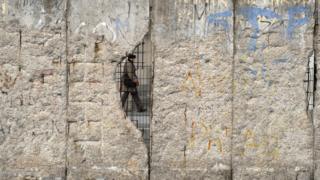 Getty Images
Today marks the 70th anniversary of an of import moment in modernistic history, when Deutschland was divided into ii post-obit the end of World War Two - part of which involved the Berlin Wall being congenital (seen in this film)
Today marks the 70th anniversary of an important moment in mod history, when Germany was divided in two, into Due west and East, following the end of Earth State of war Two.
The Germany (West Germany) was created from areas occupied by the British, French and Americans, while the German Democratic Republic (Eastward Deutschland) was established from territory occupied past the Soviet Marriage.
As part of this partitioning, the Berlin Wall was built in 1961 to separate the capital metropolis between the ii halves.
East and West Federal republic of germany existed as separate countries until the autumn of the Berlin Wall in November 1989, bringing the country back together.
This partition was a pregnant part of something called the Cold War, which was a 40-yr disharmonize between the eastward and the due west, which came to an cease in 1991, just after the Berlin Wall came down.
Read on to find out more virtually the Cold War and why it was such a meaning part of modernistic history.
What was the Cold State of war?
The Cold State of war was a sectionalization betwixt Russia and western countries (the The states and its allies, like Britain), which started in the 1940s and lasted until 1991.
It is hard to pinpoint an exact date for when it started. It was a state of war between ii ideas and ways of ruling - communism (the due east) and capitalism (the west).
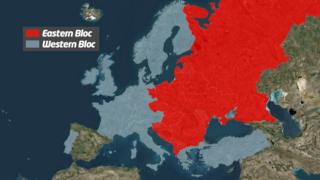
This map shows the west in blue and the eastward in red, with the Us besides on the side of the due west
The Russians operated a communist country (from 1922 to 1991), while western countries similar the U.s. were capitalist countries.
Throughout the Cold War, communist and backer nations tried to out-do each other, competing to develop the best technologies and weapons.
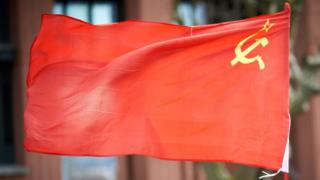 Getty Images
The flag of the communist ability in the Cold State of war was a red flag with a golden hammer crossed with a sickle, which is a symbol of communism
What is commercialism?
In a capitalist system:
- Citizens are immune to have their ain businesses and brand their own money
- It revolves around something called complimentary markets, in which companies and business people tin buy and sell products and services, depending on what customers and the public want (which also determines how much things will cost), with piddling or no government control
- Usually, there are multiple political parties that correspond different parts of society (merely this doesn't ever have to be the instance in a capitalist society)
- Governments are called in democratic elections, in which citizens have their say on who they want to exist in charge (a democracy)
- People's rights and freedoms are an of import part of life, including existence able to say what they feel (freedom of spoken language)
- The press enjoys freedom of speech as well and is not controlled by the state
What is communism?
In a communist organization:
- Businesses are owned by the state and any wealth from them is controlled past the people in ability
- There is one political party in accuse
- There is no opportunity for citizens to vote for who they want to exist in charge or modify the authorities (a dictatorship)
- It is more of import to serve the state and exist obedient to those in charge than it is to have personal freedoms
- The media is controlled by those in power
Where did communism come up from?
To understand why the Cold War started, information technology is necessary to understand where communism in Russia came from, as it was the first time that this system of ruling had been introduced.
In 1917, the Bolsheviks took power in Russia later the October Revolution and a new political organisation called communism was introduced. (In the years to follow, some other countries including China, North korea and Cuba would prefer communism too.)
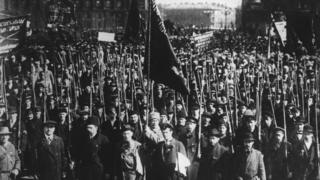 Getty Images
A group of demonstrators get together in Palace Square, Moscow in May 1917
In 1922, Russia - along with countries under its command - formed the Matrimony of Soviet Socialist Republics (the USSR) - better known as the Soviet Union (or the Soviets). It was a communist group and did not agree with western, capitalist countries or their way of ruling.
Why did the Cold State of war start?
The Cold War started in the aftermath of World War 2, but its foundations came earlier than this.
During World State of war Two, something unusual happened. Afterward Hitler started to invade USSR-controlled territories, the Soviet Matrimony joined forces with Britain - traditionally its political enemy - to fight against Germany.
When the Japanese bombed Pearl Harbour in December 1941 and the United states of america joined World War Two besides, this brought together the USSR and the US - also traditionally political enemies.
Together, Uk, the Usa and the USSR became unlikely allies known as the Grand Alliance, fighting against the Nazis. This is why 1941 is sometimes said to be the start of the Cold War, when these three nations were brought together.
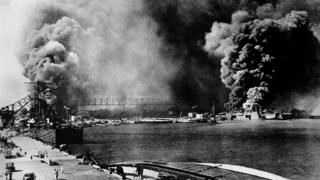 Getty Images
In December 1941, the Japanese attacked Pearl Harbour, which led to the United states of america joining Globe State of war Ii
In two divide meetings in 1943 and 1945, the leaders of Britain, the The states and the USSR met to decide how they would deal with the Nazis in Europe. Winston Churchill was the Britain prime number minister, Franklin D Roosevelt was the U.s. president and Joseph Stalin was premier of the USSR.
But past the time it came to putting into action what they had agreed, the leaders had changed. By the time of an of import coming together in 1945 in Potsdam in Berlin, at that place was a new Great britain prime government minister (Clement Atlee) and a new US president (Harry S Truman).
President Truman was more than outspoken than President Roosevelt virtually his dislike of Stalin and communism, and Stalin didn't like how the U.s.a. treated the USSR. Britain and the United states of america did non trust that Stalin was going to let elections to happen in areas which the USSR would control later the war - something that was agreed at an before coming together.
Even during the war, Stalin had plans to take over Eastern Europe. As the Soviets drove the Nazis back, they had begun to occupy large parts of Eastern Europe and they wanted to impose communism in these areas.
This was a worry for the US and Britain, but the Grand Alliance still had to work together to defeat the Japanese.
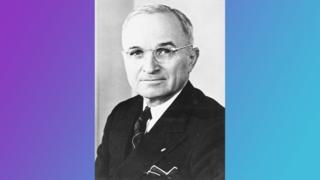 Getty Images
United states President Truman (pictured here) was more vocal than Roosevelt well-nigh his dislike of Stalin and communism
In 1945, the US dropped two atomic bombs on Japan - 1 on Hiroshima and another, three days subsequently, on Nagasaki. Effectually 214,000 people lost their lives.
While the Japanese surrendered from the war a few days after, some take said that dropping the bombs like this was also a way for the US to show the Soviet Union how powerful it was and who was really in command.
Shortly afterwards, World War Two was over - but relations between the Chiliad Alliance had become tense and the Cold State of war had begun.
Cold War begins
After World State of war Two was fought to ensure people'southward freedoms, the Western allies became worried that in many parts of Europe, Nazi dictatorship was but being replaced by communist dictatorships.
In 1946, Churchill - who was UK prime minister again - declared that an "iron mantle" had come down across Europe, every bit it was divided upwards between the east and the w. This became known as the famous iron pall speech.
Between 1945 and 1948, the Soviets made Albania, Bulgaria, East Germany, Romania, Poland, Hungary and Czechoslovakia communist nations. This gave them a buffer zone to protect the USSR from whatever potential future invasions by the west.
Greece looked like it was the next country in Eastern Europe to go communist. Britain didn't accept the money to stop it from happening and the west became worried virtually how communism was spreading.
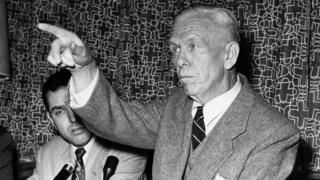 Getty Images
General George Marshall came up with a plan that might help to stop the spread of communism in Eastern Europe
In March 1947, the US vowed to help to stop this from happening. President Truman made a speech in which he promised that the US would help whatsoever country that took a stand against communism. It was called the Truman Doctrine. In June that year, he sent General George Marshall to run into what could be done. Marshall came up with a plan - Marshall Aid - that would offer European countries money to recover subsequently World War Ii and reject communism.
In 1947, Stalin had ready Cominform - an brotherhood of communist countries - and he forbade whatever of them from applying for Marshall Aid. So, in Jan 1949, the Soviets set up a council chosen Comecon to run its very own Molotov Program of financial aid to endeavor to keep the communist nations on its side. In a style, both sides were trying to buy back up from countries.
Why was Berlin so of import in the Cold War?
Berlin would become a significant city in the conflict between the Due west and the Soviets.
After Earth State of war Ii, Germany had been divided upward into four between the U.s., Britain, France and Russian federation. Berlin was likewise divided in half, even though the west'southward portion of Berlin was surrounded past Soviet areas. It was the last gap in the USSR's buffer zone - and Stalin wanted control of it.
The Allies used money from Marshall Assist to help Germany to recover later on the war. But the areas controlled by the USSR were poor and it made communism look bad. Stalin ready out to take over Berlin.
In June 1948, Britain, French republic and the US joined their areas of Federal republic of germany together in what would become known as West Germany, with West Berlin as its majuscule. Between 1949 and 1961 an estimated 2.7 million East Germans left for Due west Germany in the hope of a amend life.
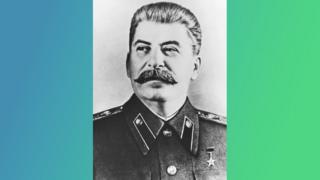 Getty Images
Joseph Stalin wanted to take control of Berlin
Stalin did not similar whatever of this. On 23 June 1948, he cut the west's road and rail admission to Westward Berlin, in what became known as the Berlin Blockade.
This meant West Berlin could merely be accessed by the air. For 11 months, something called the Berlin Airlift supplied Westward Berlin with nutrient and supplies from the air, equally the west didn't want to forcefulness their manner through by land and hazard starting another war.
The blockade was lifted in May 1949, just the conflict betwixt East and West Germany was more strongly established than ever.
The Cold War intensifies
In 1949, Nato - the North Atlantic Treaty Organisation, which was a group of countries working together to defend themselves - was formed as a issue of the Berlin Blockade. Information technology included the Us, UK, Canada, Due west Germany, Portugal, France, Belgium, Holland, Denmark, Iceland, Italy and Luxembourg. The USSR was not invited to join the group.
In 1953, Stalin died and Nikita Khruschev became leader of the Soviets. He spoke about wanting to amend relations with the w and bring more peace, but this did not happen. In fact, 1953 to 1960 was one of the tensest periods of the Common cold War.
In May 1955, Khruschev set up a military group of communist countries called the Warsaw Pact, in response to the formation of Nato. It included the USSR, Poland, Hungary, Czechoslovakia, Republic of bulgaria, Romania, East Germany and Albania. Western countries were not part of it. This merely fabricated the feeling of east versus w fifty-fifty stronger.
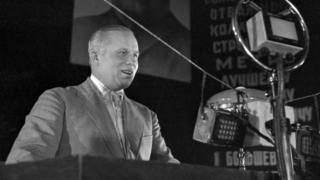 Getty Images
Nikita Khruschev took over as leader of the USSR when Stalin died in 1953
The world was now very much divided betwixt two opposing sides who had different ideas.
While these groups weren't necessarily fighting against each other direct in concrete battles, if whatever opposing countries got into a disagreement about something, the threat that this could escalate into something much bigger became very real.
The 2 sides also got involved in other conflicts like the Korean State of war in (1950-1953) and the Vietnam State of war (1955-1975) on opposing sides, which heightened the partitioning between them.
Past the early 1960s though, the situation in Berlin had become embarrassing for the Soviets. About two,000 refugees were escaping from the east and fleeing to the west every single day. Khruschev needed to take action to assert the USSR's ability.
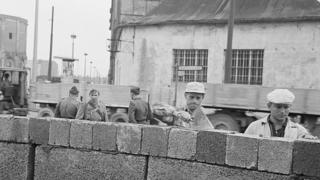
When the west refused to exit its zone in West Berlin, on 13 August 1961 Khruschev closed the border betwixt Due east and West Berlin - and the Berlin Wall was built.
 Getty Images
This picture shows Due east German workers building the Berlin wall in 1961, while beingness watched by communist police
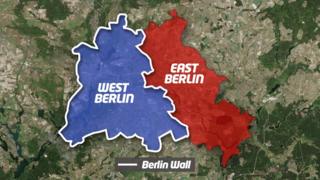
This map shows how the Berlin Wall was built effectually the exterior of West Berlin
This became more than just a barrier dividing Berlin though. It became one of the most famous symbols of the Cold War division.
The infinite race and the artillery race were likewise heightening tensions.
What was the infinite race?
The infinite race was a competition betwixt the e and the west during the Common cold War for who could dominate space exploration.
In 1957, the Soviets launched the kickoff satellite Sputnik to orbit around the Earth. Iv years later, they sent the get-go man into space.
To enjoy the CBBC Newsround website at its best you will need to have JavaScript turned on.
The Usa responded past sending their own homo into space and pledging to become the commencement nation to put a homo on the Moon by the end of the 1960s. They achieved this in 1969.
What was the artillery race?
During the Cold War, the west and east competed for who could build the best missiles and bombs. This was known every bit the arms race.
Ever since the The states dropped the diminutive flop on Hiroshima in 1945, the USSR wanted to accept its ain similar weapon.
On 29 August 1949, the Soviets set off their first nuclear bomb.
But one of the tensest moments of the whole Cold War came in 1962, with the Cuban missile crisis.
 Getty Images
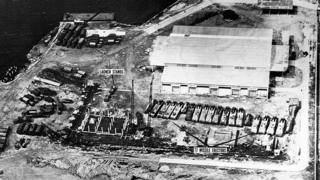
This intelligence photo shows missile stands lined up in Cuba during the Cuban Missile Crisis
For xiii days in October 1962, the world stood on the brink of nuclear war when the Soviet Union provided communist Cuba with missiles that they could use against the US, who wanted to invade Republic of cuba and remove its leaders (the Castros) from power.
The state of affairs was eventually defused. Some say that information technology paved the style for sides to work together on agreements after in the Cold War about the evolution of weapons.
How did the Common cold War end?
In that location were several factors that led to the end of the Cold War.
During the 1970s, tensions between the w and east relaxed a little during a menstruation called detente.
Agreements were signed to encourage more peaceful relations, and Soviet and The states crafts even docked together in space. The US allowed China - a communist nation - to join the Un and, in 1972, Usa President Richard Nixon fifty-fifty visited Prc.
But these turned out to be little more than attempts to make the world think that everyone was getting forth. Neither side stuck to their end of the agreements they'd made and their involvement in wars in Afghanistan, Nicaragua and Angola in the late 1970s showed the divisions were still very much there.
But some countries were getting fed upwards about how much control the Soviets had over their lives. This had resulted in uprisings, which the USSR crushed, but it showed a weakening of the Soviet's communist ideas in Eastern Europe.
The arrival of 2 leaders in the 1980s changed everything - United states President Ronald Reagan in 1980 and USSR premier Mikhail Gorbachev in 1985.
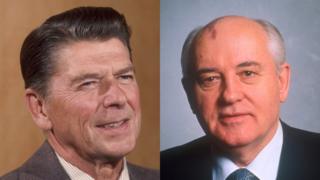
The arrival of these two leaders - US President Ronald Reagan in 1980 and USSR premier Mikhail Gorbachev in 1985 - changed the course of the Cold War
Reagan was chosen partly considering he was critical of the Soviet Union and strongly anti-communism. In a spoken language in 1983, he called the USSR an "evil empire". He increased US spending on the military and worked closely with UK Prime number Government minister Margaret Thatcher to exert pressure on the Soviet Union, to the point that it had no choice but to back down.
Gorbachev, meanwhile, realised he couldn't friction match what the United states was spending on weapons, so started talks to limit the production of nuclear weapons on both sides. If Russia was going to be a potent, global superpower, he knew it would have to make up with the west. He also introduced more popular policies promoting more freedom of speech and restructured the economic system.
Past the 1980s, the west and the USSR were learning how to alive aslope each other more, but at that place was however unrest in Eastern European countries where people were poor and wanting to flee from the east. By the end of 1980s, the increased freedom and openness that Gorbachev had promoted in the USSR began to spread across Eastern Europe.
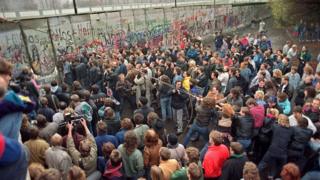
The Berlin Wall had come to be a symbol of oppression and everything that was wrong with Soviet rule. On 8 Nov 1989, the Berlin Wall came down and the border was opened.
You can spotter Newsround'due south special programme to marker 25 years since the Berlin Wall came downward here.
 Getty AFP
There were great celebrations equally the Berlin Wall was torn down in 1989
Due to economic problems, unrest in Eastern Europe and USSR defeat in Afghanistan, in December 1991, communism in the USSR - and the Cold State of war - came to an end.
Russia declared itself a commonwealth and elected a man called Boris Yeltsin as its president.
What is the situation today?
Even though the Common cold War has come to an end, tensions between Russia and the west still make headlines today.
In Feb 2019, the The states and Russian federation suspended their involvement in a treaty, which both nations signed back in 1987, towards the end of the Common cold State of war.
The treaty - called the Intermediate-Range Nuclear Forces Treaty - banned both nations from using curt and medium-range missiles (except ocean-launched weapons).
By 1991 - when the Cold War came to an cease - nearly 2,700 missiles had been destroyed.
 AFP
AFP
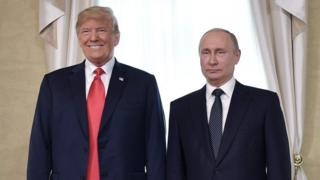
In February 2019, US President Donald Trump and Russian President Vladimir Putin said their countries are suspending their involvement in an agreement that both of their countries signed in 1987 towards the end of the Cold State of war
Only on one Feb, the US said it would withdraw from what was agreed in the treaty and Russian President Vladimir Putin said that Russia would starting time developing new missiles also.
While this Cold War has come to an end, nations in the east and west don't always agree with each other.
Merely Malcolm Craig - a senior lecturer in US history at Liverpool John Moores Academy - explains: "Russia is not the Soviet Union and its international position is quite, quite different. It is much more than tightly integrated into the global economical arrangement than the USSR was."
zimmermannfixecition.blogspot.com
Source: https://www.bbc.co.uk/newsround/47122488

Post a Comment for "Chapter 17 Section 3 Cold War in the Atomic Age Guided Reading"