What Type of Person Reads Research Papers
Guide to Reading Academic Research Papers
Acquire to tackle this laborious procedure with a systematic approach!

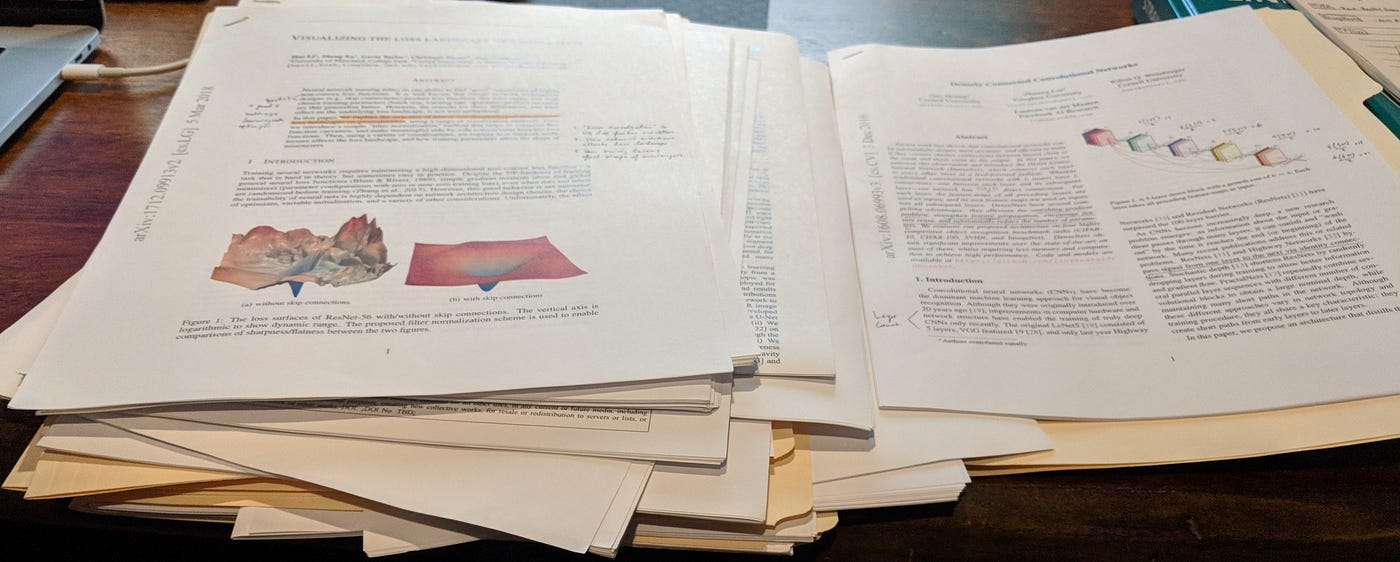
Working in data science and motorcar learning is an exciting and challenging field. New techniques and tools are constantly percolating and honestly, it can feel overwhelming. Many of these new developments are establish and first revealed in bookish enquiry articles. Extracting noesis from these articles is difficult because the intended audience of these papers tend to be other researchers. Yet in society to stay current reading papers is an essential skill — luckily ane that can be improved with diligence and practise.
In graduate school , you go good (should get good…) at reading papers and ingesting research. Not everyone will go training in this skill, that doesn't mean you shouldn't benefit from the knowledge these papers hold. Public tax money is how most of this research gets funded anyways! The goal here is to democratize academia, just a bit, and provide y'all with a scaffolding to apply when walking through a paper.
The way I read papers is not significantly unique, simply it is constructive and has served me well. Continue in mind information technology is not the simply style, many techniques exist and as you read more and more I am sure you volition find your own unique style.
This guide is broken downwardly as follows:
- Learning this skill will help you! I promise
- And then I hear reading a paper is difficult. Why?
- How are papers typically organized?
- My "bullet proof" arroyo to reading papers
- Tools to help you get the chore washed
Why Learn to Read Papers?
Reading papers certainly builds character considering Information technology often takes many hours and at that place is no guarantee y'all walk away with the whole story. This is not to disparage yous, merely just to be open and transparent. Reading papers is difficult, there are no two ways virtually information technology. Advances in fields such as machine learning, deep learning, data science, databases, and data engineering often come in the course of academic inquiry, whose linguistic communication is that of bookish papers. Call up nigh some of the techniques you might use: Convolutional Neural Networks, PCA, and AdaBoost (even Deep Boosting!). These all came out of research, and yes they all have papers. Also, consider that there are many papers on the awarding and use of these techniques and when y'all are trying to solve a specific problem, these papers tin exist critical. Beyond staying electric current with inquiry information technology is also worth traveling to the past and giving older papers a read. You will acquire so much. I promise.
Looking at the field of deep learning it seems as though a new disquisitional newspaper is coming out every few days or weeks. The simply style to stay on meridian of it is to get a concur of the paper and give it a read.
Where the Difficulties Arise…
Here is a figure from a 2017 scientific newspaper¹ by Hubbard and Dunbar, about reading scientific papers. Scientific Paper inception!
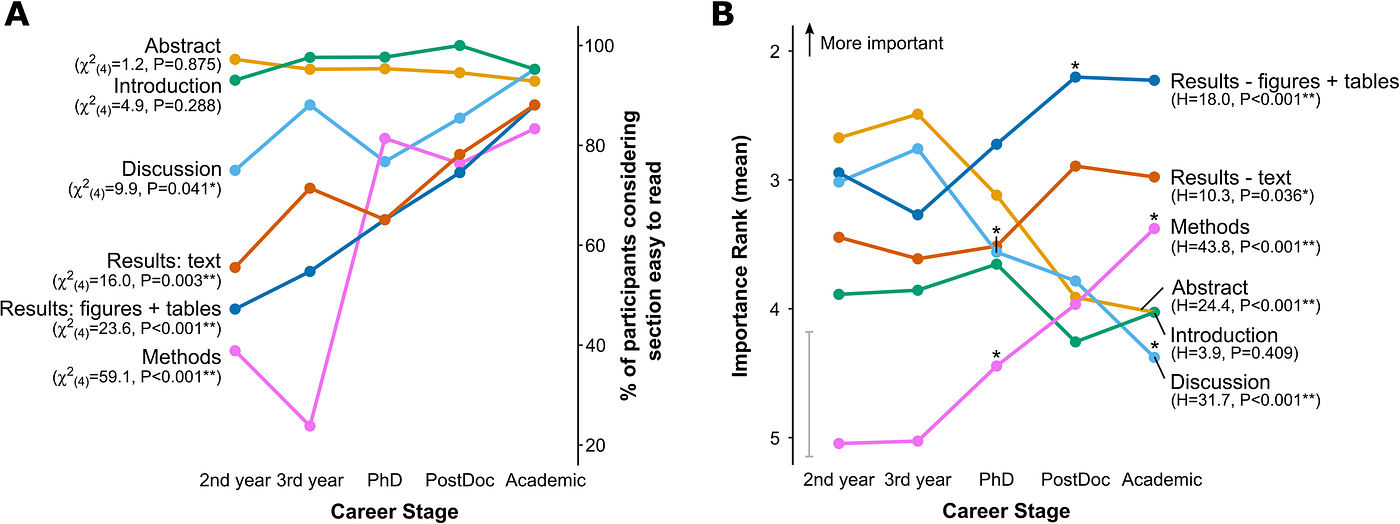
A: The proportion of participants considering a section easy to read (presented as 'Somewhat easy', 'easy' 'very like shooting fish in a barrel' combined) as a office of career stage. Results of Chi-square tests are indicated on the left hand side. B: The mean importance rank of sections every bit a function of career stage. Error bars are omitted from individual points for clarity, with the sole error bar in grey representing the largest 95% conviction interval for any of the information points. Asterisks higher up data points indicate significant differences in response compared with the previous career phase as determined by Mann-Whitney post-hoc tests.
One unsurprising issue indicates the farther an academic progresses into their career, the easier they find each section of a paper to read. An interesting betoken is how the diverse career stages view the importance of each section. Methods, Results and figures seem to be very important, ostensibly because as academics they take greater skill in their field, assuasive them to be critical of a paper'south methods. It likewise means they know their field very well, thereofore, the introduction and abstract have less importance. Early stage PhD students find the methods, results, and figures fairly hard to empathise. This makes perfect sense as those are the areas of a newspaper that require the most knowledge of a field to get through. Y'all are probable to have a similar experience.
What is it exactly that makes going through this procedure so difficult and fourth dimension consuming?
- Authors tend to assume significant background knowledge from readers
- Academic syntax is dense and thus difficult for readers to parse
- Mathematical expressions are typically condensed and equations reordered for concision, often skipping steps in derivations
- Substantial knowledge gaps are filled if a reader has read cited papers (sort of similar — y'all need feel to get a job, but need a task to get experience!)
- Not all conclusions drawn are correct. Small sample size and power, poor study design, researcher bias, and selective reporting ensures that you must exist a disquisitional reader!
Conspicuously there is a lot to consider when reading a newspaper. Scared? Time to lighten the mood. Here is a hilarious article written on the horrors of reading papers by Dr. Adam Ruben from Science. Information technology shows even scientists tin concord that papers are both difficult to read and given how dense they are, will keep you regular.
Think about this, the more papers you read, the more you lot will learn and the faster this procedure of reading becomes. Trends beginning cropping up into obviously view, and you begin to gain insight into the scientific method, understand what certain authors and groups are working on, and form an appreciation for the field y'all are learning about. Over time all of this knowledge and skill builds into your ability to read papers quicker, more efficiently and with greater success. Learning to read papers is akin to learning to eat. Information technology is messy at first, and your palette is not very well developed. Merely over fourth dimension your eating experience enhances and you learn more about what you like and don't like and when a chef'southward meal is expert and poor.
How Papers are Organized
Good news hither. The overwhelming majority of papers follow, more or less, the same convention of arrangement:
- Title: Hopefully catchy, maybe sexy! Includes boosted info about the authors and their institutions
- Abstract: High level summary
- Introduction: Background info on the field and related research leading up to this paper
- Methods: Highly detailed department on the study that was conducted, how information technology was gear up upwards, any instruments used, and finally, the process and workflow
- Results: Authors talk about the information that was created or nerveless, it should read as an unbiased business relationship of what occurred
- Discussions: Here is where authors interpret the results, and convince the readers of their findings and hypothesis
- References: Any other work that was cited in the body of the text volition show up here
- Appendix: More figures, boosted treatments on related math, or actress items of interest tin observe their way in an appendix
Developing a Systematic Arroyo
When you sit down to read it's important to have a plan. Simply starting to read from page one to the terminate will probably do you no good. Beyond retaining limited information, you will be exhausted and take gained very little for the tremendous effort. This is where many people stop.
Exercise program to spend anywhere from 3–6 hours to really digest a paper, remember they are very dense! Be ready and willing to make several passes through the newspaper, each time looking to extract dissimilar information and understanding. And please, exercise yourself a favor and practice non read the paper front to end on your first pass.
Below are two lists. (i.) the systematic approach I have, more than or less, when reading a newspaper (2.) a full general listing of questions I endeavor to answer as I go through the newspaper. I typically add more specific questions depending on the paper.
Let'due south get started!
- Try to find a quiet place for a few hours and catch your favorite drinkable (could be coffee, tea, or anything actually). Nowadays I often detect myself working in splendid java shops².
- Start by reading the championship and abstract. Aiming to proceeds a high level overview of the newspaper. What are the principal goal(south) of the author(s) and the high level results. The abstruse typically provides some clues into the purpose of the paper. Recall of the abstract as advertisement.
- Spend well-nigh 15 minutes skimming the newspaper. Take a quick look at the figures and note any keywords to wait out for when reading the text. Try to get a sense for the layout of the paper and where things are located. You will be referencing back and forth between the dissimilar sections and pages afterward on, information technology helps knowing where stuff is located. Attempt not to spend time taking any notes or highlighting/underlining anything but nevertheless.
- Turn your attention to the introduction. The more unfamiliar I am with the paper/field, the longer I spend in the intro. Authors tend to do a good job consolidating groundwork info and providing copious amounts of references. This section is usually the easiest to read and it most feels like you are reading from a textbook. Take notes of other references and groundwork info you lot don't know or desire to examine further.
- This part is extremely critical. Advisedly step through each effigy and try to get a feeling for what they are telling yous. When I was an undergrad, my neuroscience mentor gave me some good communication. Paraphrasing: "Figures contain some of the most important information in a paper. Authors spend a lot of time creating them and deemed the information they incorporate to exist important enough to communicate to the reader using a visual. Pay particular attention to them." You will not sympathize all the figures very well the offset fourth dimension you step through them, only you will gain some thought of what the authors recollect is about of import, and you will also reveal valuable information almost what to pay attention to when you read the other sections.
- Then far yous take probably spent about an hour. Take a break. Walk a bit, bask a croissant!
- At present you are ready to make a first pass through the paper. This time you should first to accept some high level notes. You volition come upon words, and ideas that are foreign to you. Don't experience like you need to stop at every thing that does not make sense, you lot tin can simply marker it and move on. Aim to spend about an hour and a half. You lot don't want to get bogged down but notwithstanding in all the gory details. The goal of the first pass is to get acquainted with the paper. Like a showtime date. Your going to acquire about the paper, enquire some skilful questions, perhaps get in laugh. But y'all don't desire to get into every single little detail. That is rude. Begin once again with the abstract, chop-chop skim through the introduction, give the methods section a diligent pass. Pay attending to the overall set upward, the methods section includes a ton of detail you don't demand to scrutinize every role at this indicate. Finally, read the results and discussion department aiming for some clarity on the key findings and how these findings were determined. Retrieve, the authors are trying to convince yous, the reader, of the merit and findings of their work.
- Saved by the bell. Have a break, do some jumping jacks and get the blood flowing. Unless yous're in a coffee shop. Then don't do that.
- Now that you have a proficient overview of the paper you are going to become into the nitty gritty of the figures. Having read the methods, results and discussion section, you should be able to extract out more gems from the figures. Find those gems. Aim to spend another 30 minutes to an 60 minutes on the figures.
- Y'all should experience confident in taking a second full laissez passer through the paper. This time yous volition be reading with a very critical center. This pass can take a long time an hour or 2, you can too save this for afterwards in the solar day, or the following day. Pay particular attending to the areas you marked as beingness difficult to understand. Go out no word undefined and brand sure you lot empathise each judgement. This pass you are trying to actually learn the paper. Skim through areas you lot feel confident in (abstract, intros, results). The focus should be on shoring upwardly what you did not empathize previously, and gaining a command of the methods department and finally being a critical reader of the discussion section. The discussion section is where you tin consider the authors' reasoning/rational and take what you lot learned from reading the paper and weigh it against show supplied in the newspaper. This section should spark some interesting questions for y'all to ask your friends, or colleagues. You can fifty-fifty email the authors of the paper with an insightful question! Information technology might take them a while to get back to you, but authors do bask having dialogue regarding their research and are typically more than happy to answer a question for a reader.
- At this signal, you should feel confident talking virtually the newspaper with colleagues, thinking critically nigh the results, and existence able to compare the work to other research in the field (if you have read other papers). To retain and enforce what you accept learned, I suggest you write about the paper. Information technology can simply be a few paragraphs about what you learned and the significance of the results. You lot can reference the list of questions you were answering as you read through the paper.
As mentioned above, here is a general list of questions to help guide you lot. If you can reply these you have a solid understanding of the paper, at least to where you can communicate intelligently about information technology to others.
          one. What previous research and ideas were cited that this paper is edifice off of? (this info tends to alive in the introduction)
two. Was at that place reasoning for performing this research, if so what was it? (introduction department)
iii. Conspicuously list out the objectives of the study
four. Was whatsoever equipment/software used? (methods section)
5. What variables were measured during experimentation? (methods)
half dozen. Were any statistical tests used? What were their results? (methods/results section)
vii. What are the main findings? (results section)
8. How do these results fit into the context of other research and their 'field'? (discussion section)
9. Explicate each effigy and discuss their significance.
10. Tin can the results be reproduced and is at that place any code available?
11. Proper noun the authors, year, and title of the paper!
12. Are whatsoever of the authors familiar, practice you know their previous work?
thirteen. What key terms and concepts practice I non know and need to look upward in a lexicon, textbook, or inquire someone?
14. What are your thoughts on the results? Do they seem valid?
I recommend finding people either in person or online to discuss the paper. Get-go a periodical club with a goal of getting through 1–ii papers a month. The amount of extra insight I accept gained from discussing a paper with a friend is immense. Remember.. the only matter better than suffering through a paper alone, is suffering through it with friends!
On another annotation there was a good commodity written past Keshav³ on how to read a paper. He introduces and explores a 3 phrase arroyo that might exist of some involvement to you lot. Give it a read every bit well!
Tools to Help You Become the Job Done
You lot can find papers primarily from several sources:
- arXiv: is an open up-access repository (maintained at Cornell) where you can freely download and read pre-print research papers from many quantitative fields. Here is some more general info almost arXiv. Many papers you discover on the web volition link back to the arXiv paper.
- PubMed: They say it best: "PubMed Central® (PMC) is a gratuitous total-text archive of biomedical and life sciences journal literature at the U.S. National Institutes of Health'due south National Library of Medicine (NIH/NLM)." PubMed has a robust search feature if yous are looking for medical or life scientific discipline related papers.
- Google Scholar: I apply google scholar just as I would employ google. Simply search for a topic, author or paper and google gets to work, on your behalf. Every bit Google puts it "Google Scholar provides a simple mode to broadly search for scholarly literature. From one identify, you can search across many disciplines and sources: articles, theses, books, abstracts and court opinions, from academic publishers, professional person societies, online repositories, universities and other web sites. Google Scholar helps you lot notice relevant work beyond the world of scholarly research."
- Social media: I discover out about a lot of new papers simply by following and keeping up with several people who actively publish. Added bonus.. they typically push other papers they detect interesting and which y'all might desire to know about or read.
- Friends and colleagues: Detect people interested in the same stuff as you lot, read papers with them and larn from each other. I get recommendations for adept papers from friends. They act as good filters.
- Academy: going to your local college or university (if there is one shut by) gives you lot access to libraries, librarians (very helpful search wizards!) and many journals where yous can detect and read articles that are typically backside online paywalls.
As you begin to read more papers you are going to want to store them somewhere. Tossing PDFs into a folder on your drive is all well and good, simply there are creature comforts missing. Most researchers and grad students use a reference manager. Zotero and Mendeley are very popular, I like Zotero. Recently, I accept been using PaperPile. I like PaperPile considering it is lightweight, lives in my browser, and uses Google Drive to back up and store all my PDFs. It has a uncomplicated, refreshing user interface, and it has a really adept tagging and binder hierarchy system. I can also annotate PDFs in my browser and build citation lists when I write. You get a lot of these features with nigh any reference managing director, but I happen to like PaperPile all-time.
A reference manager will quickly become your best friend as you collect and read more than and more papers.
Cheers for reading through this. I promise you found information technology helpful and it gave you some proficient ideas when tackling your next paper. Well-nigh people accept their ain unique procedure when reading a paper. I am sure you will develop your own tweaks in fourth dimension, hopefully this is a adept template for you to get started.
For now just trust the process.
I am also hoping that we will go some good feedback and comments with other tips and tricks from readers.
Cheers,
Kyle
Reach me at: datasci@kmshannon.com
linkedin.com/in/kmshannon/
twitter.com/ButFirstData
[one] Hubbard, Yard. East., & Dunbar, S. D. (2017). Perceptions of scientific enquiry literature and strategies for reading papers depend on bookish career stage. PloS one, 12(12), e0189753.
[2] Shout out to Chris at CoffeeCycle! Simply the best coffee in San Diego.
[3] Keshav, S. (2007). How to read a paper. ACM SIGCOMM Computer Communication Review, 37(iii), 83–84.
zimmermannfixecition.blogspot.com
Source: https://towardsdatascience.com/guide-to-reading-academic-research-papers-c69c21619de6

Post a Comment for "What Type of Person Reads Research Papers"