describe how to locate scholarly (peer reviewed) resource material what worked and what didnt work?
Credible Sources and How to Spot Them
A credible source is complimentary from bias and backed upwards with evidence. It is written by a trustworthy author or system.
There are a lot of sources out there, and it can be hard to tell what's credible and what isn't at starting time glance.
Evaluating source credibility is important for your research. Information technology ensures that you lot collect accurate information to back up the arguments you make and the conclusions you draw.
Types of sources
There are three types of sources: main, secondary, and 3rd.
Primary sources are oft considered the most credible in terms of providing evidence for your argument, as they give you direct evidence of what you are researching. Nonetheless, information technology'south up to you lot to ensure the data they provide is reliable and accurate.
Y'all volition likely use a combination of the three types over the course of your research process.
| Type | Definition | Case |
|---|---|---|
| Main | First-hand evidence giving you direct access to your research topic |
|
| Secondary | Second-hand information that analyzes, describes, or evaluates primary sources |
|
| Tertiary | Sources that identify, index, or consolidate principal and secondary sources |
|
How to place a apparent source
There are a few criteria to look at right away when assessing a source. Together, these criteria form what is known as the CRAAP exam.
- The information should exist upwardly-to-date and current.
- The source should exist relevant to your research.
- The author and publication should exist a trusted authority on the subject field you are researching.
- The sources the author cited should be easy to find, clear, and unbiased.
- For spider web sources, the URL and layout should signify that it is trustworthy.
Scribbr Commendation CheckerNew



The AI-powered Citation Checker helps yous avoid common mistakes such equally:
- Missing commas and periods
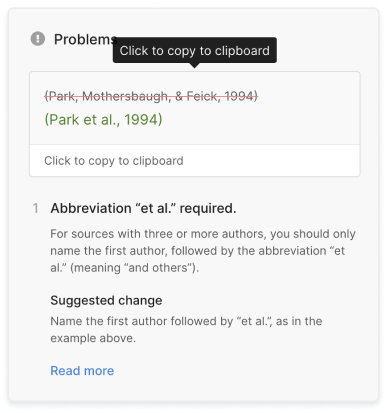
- Incorrect usage of "et al."
- Ampersands (&) in narrative citations
- Missing reference entries
Acquire more
The CRAAP test
The CRAAP test is a catchy acronym that will help you lot evaluate the credibility of a source yous are thinking nigh using. California State Academy developed it in 2004 to help students call up best practices for evaluating content.
- Currency: Is the source upwards-to-appointment?
- Relevance: Is the source relevant to your research?
- Authority: Where is the source published? Who is the author? Are they considered reputable and trustworthy in their field?
- Accuracy: Is the source supported by evidence? Are the claims cited correctly?
- Purpose: What was the motive behind publishing this source?
The criteria for evaluating each bespeak depend on your inquiry topic.
For case, if y'all are researching cutting-edge scientific applied science, a source from 10 years ago will not exist sufficiently current. However, if you are researching the Peloponnesian War, a source from 200 years ago would exist reasonable to refer to.
Be careful when ascertaining purpose. It can be very unclear (often by design!) what a source's motive is. For example, a periodical article discussing the efficacy of a particular medication may seem apparent, but if the publisher is the manufacturer of the medication, you lot tin can't be sure that information technology is free from bias. As a rule of thumb, if a source is even passively trying to convince you lot to buy something, it may non exist apparent.
Newspapers can be a great way to glean commencement-hand data nigh a historical event or situate your inquiry topic inside a broader context. However, the veracity and reliability of online news sources tin vary enormously—exist sure to pay careful attention to authority here.
When evaluating academic journals or books published by university presses, information technology'southward ever a adept dominion of thumb to ensure they are peer-reviewed and published in a reputable journal.
What is peer review?
The peer review process evaluates submissions to academic journals. A console of reviewers in the same subject field decide whether a submission should be accepted for publication based on a prepare of criteria.
For this reason, academic journals are often considered amidst the most credible sources you can use in a inquiry project– provided that the journal itself is trustworthy and well-regarded.
Where to detect credible sources
What sources y'all use depend on the kind of research you are conducting.
For preliminary research and getting to know a new topic, you lot could utilize a combination of main, secondary, and tertiary sources.
- Encyclopedias
- Textbooks
- Websites with .edu or .org domains
- News sources with first-mitt reporting
- Inquiry-oriented magazines like ScienceMag or Nature Weekly.
As you lot dig deeper into your scholarly research, books and academic journals are commonly your best bet.
Bookish journals are oft a great identify to detect trustworthy and credible content, and are considered one of the virtually reliable sources you lot tin can use in academic writing.
- Is the journal indexed in bookish databases?
- Has the journal had to retract many articles?
- Are the journal'southward policies on copyright and peer review easily available?
- Are in that location solid "About" and "Scope" pages detailing what sorts of articles they publish?
- Has the author of the article published other articles? A quick Google Scholar search will evidence you.
- Has the author been cited by other scholars? Google Scholar also has a function called "Cited By" that can evidence you lot where the writer has been cited. A high number of "Cited By" results tin often exist a measurement of credibility.
Google Scholar is a search engine for bookish sources. This is a nifty place to kick off your enquiry. You can also consider using an academic database like LexisNexis or regime open information to go started.
Open up Educational Resources, or OERs, are materials that have been licensed for "gratis use" in educational settings. Legitimate OERs tin can be a great resources. Be sure they have a Creative Commons license allowing them to be duplicated and shared, and see the CRAAP exam criteria, especially in the authorization section. The OER Commons is a public digital library that is curated by librarians, and a solid identify to start.
| Interdisciplinary |
|
|---|---|
| Science + Mathematics |
|
| Social Science + Humanities |
|
Evaluating web sources
Information technology can be peculiarly challenging to verify the brownie of online sources. They often practice non take single authors or publication dates, and their motivation tin can be more hard to ascertain.
Websites are non subject field to the peer-review and editing process that bookish journals or books go through, and can exist published by anyone at any fourth dimension.
When evaluating the credibility of a website, look first at the URL. The domain extension tin can help you understand what type of website y'all're dealing with.
- Educational resources end in .edu, and are generally considered the most credible in academic settings.
- Advocacy or non-profit organizations terminate in .org.
- Government-affiliated websites end in .gov.
- Websites with some sort of commercial attribute end in .com (or .co.u.k., or another country-specific domain).
In general, cheque for vague terms, buzzwords, or writing that is too emotive or subjective. Beware of grandiose claims, and critically clarify anything not cited or backed up by evidence.
- How does the website look and experience? Does it look professional to yous?
- Is there an "About Us" page, or a way to contact the author or organization if you lot demand description on a claim they take fabricated?
- Are there links to other sources on the page, and are they trustworthy?
- Tin can the information you lot found be verified elsewhere, even via a simple Google search?
- When was the website terminal updated? If it hasn't been updated recently, information technology may not pass the CRAAP test.
- Does the website have a lot of advertisements or sponsored content? This could be a sign of bias.
- Is a source of funding disclosed? This could also give yous insight into the author and publisher'due south motivations.
Social media posts, blogs, and personal websites can exist skillful resource for a situational analysis or grounding of your preliminary ideas, just exercise caution here. These highly personal and subjective sources are seldom reliable enough to stand on their own in your final inquiry product.
Similarly, Wikipedia is not considered a reliable source due to the fact that it can be edited past anyone at any fourth dimension. Yet, it can be a skilful starting point for general information and finding other sources.
Frequently asked questions
- What makes a source credible?
-
A credible source should pass the CRAAP examination, and follow these guidelines:
- The information should be upwardly-to-date and current.
- The author and publication should be a trusted authority on the field of study you are researching.
- The sources the author cited should be easy to find, articulate, and unbiased.
- For web sources, the URL and layout should signify that it is trustworthy.
- What is peer review?
-
Peer review is a process of evaluating submissions to an academic journal. Utilizing rigorous criteria, a console of reviewers in the same subject area determine whether to accept each submission for publication. For this reason, academic journals are often considered among the virtually credible sources you can utilize in a inquiry project– provided that the journal itself is trustworthy and well-regarded.
- What is the CRAAP test?
-
The CRAAP test is an acronym to help you evaluate the credibility of a source you are because using.
The CRAAP examination has 5 main components:
- Currency: Is the source up-to-date?
- Relevance: Is the source relevant to your research?
- Authorization: Where is the source published? Who is the author? Are they considered reputable and trustworthy in their field?
- Accurateness: Is the source supported by evidence? Are the claims cited correctly?
- Purpose: What was the motive behind publishing this source?
- What are examples of academic dishonesty?
-
Bookish dishonesty can be intentional or unintentional, ranging from something equally simple as challenge to have read something you didn't to copying your neighbour's answers on an exam.
You lot tin can commit academic dishonesty with the best of intentions, such equally helping a friend cheat on a paper. Severe academic dishonesty can include buying a pre-written essay or the answers to a multiple-choice test, or falsifying a medical emergency to avoid taking a final exam.
- How can you tell if a source is master or secondary?
-
To make up one's mind if a source is primary or secondary, ask yourself:
- Was the source created past someone directly involved in the events yous're studying (primary), or past another researcher (secondary)?
- Does the source provide original data (primary), or does information technology summarize data from other sources (secondary)?
- Are you directly analyzing the source itself (primary), or only using it for background information (secondary)?
Some types of source are nearly always primary: works of fine art and literature, raw statistical data, official documents and records, and personal communications (e.g. messages, interviews). If yous apply ane of these in your research, it is probably a primary source.
Chief sources are oftentimes considered the most credible in terms of providing testify for your argument, as they requite y'all direct evidence of what y'all are researching. However, it's up to you to ensure the information they provide is reliable and authentic.
Always make sure to properly cite your sources to avert plagiarism.
Is this article helpful?
You accept already voted. Thanks :-) Your vote is saved :-) Processing your vote...
zimmermannfixecition.blogspot.com
Source: https://www.scribbr.com/citing-sources/credible-sources/
 resource material what worked and what didnt work?)
Post a Comment for "describe how to locate scholarly (peer reviewed) resource material what worked and what didnt work?"